Operant Sorcery: A Praxis-Centered Metaphysics
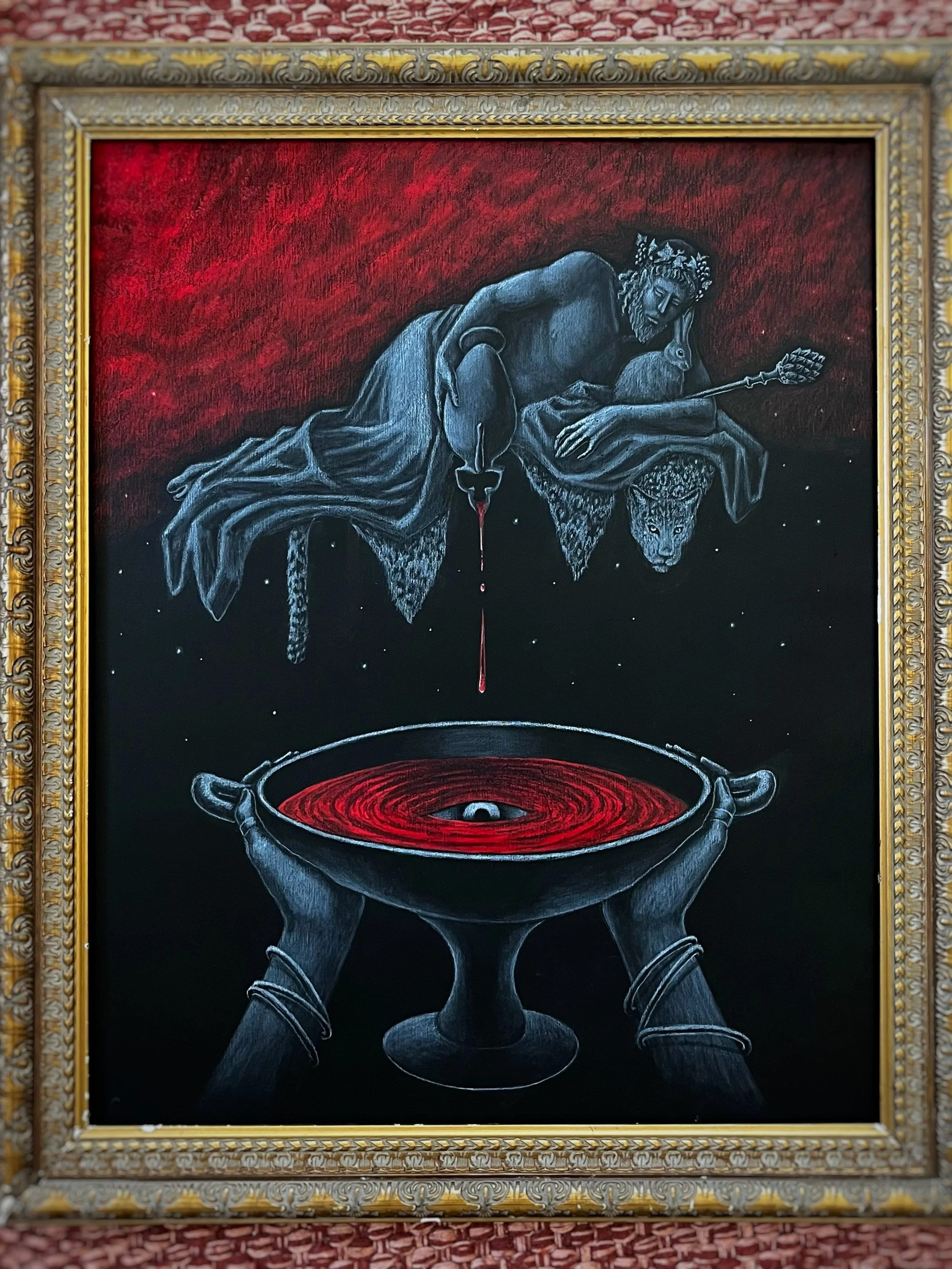
Authored by Paul W Reed, Art by Matte Black, & Edited by Georgina Rose.
The esoteric arts begin with a simple, but destabilizing recognition: the world is not sealed. Reality is not a closed system of fixed identities and inert matter. It is porous, alive, and responsive—an ecology of presences that interpenetrate one another. The boundary between self and world is not a wall, but a membrane, and under the right conditions it thins, flexes, and dissolves.
Every practitioner discovers this not through doctrine, but through experience. In ritual, in trance, in the trembling edge of ecstasy, the world reveals its permeability. Symbols cease to be representations and become participants. Intention ceases to be internal and becomes a force with weight and trajectory. The practitioner ceases to be a discrete observer and becomes a node in a living field of influence.
This is the foundation of operant sorcery: the recognition that the cosmos is not something acted upon from the outside, but something entered, inhabited, and moved from within. Sorcery works because the world itself is open to participation. It is not a machine to be manipulated, but a living continuity to be joined.
Sorcery is often described as the exertion of will upon the world, but this framing mistakes the nature of both will and world. In practice, the sorcerer does not stand outside reality issuing commands. The operator enters a state of participation—an intimacy with the living field of forces that make up the cosmos. Sorcery is not the manipulation of an external environment; it is the deliberate reconfiguration of one’s relationship to that environment.
In ecstatic states, the practitioner becomes permeable. The boundary between “self” and “force” loosens, and the operator begins to move within the world rather than against it. This is not a metaphor, it is a shift in ontological position. The sorcerer becomes a participant in the very currents they seek to influence.
Symbols function not as tools, but as thresholds. To take up a symbol is to step into a new mode of being. To invoke a presence is to completely align oneself with its pattern. To perform a rite is to enter a specific configuration of identity, intention, and cosmological relationship. The ritual does not cause the change; the ritual is the change. This change shakes the foundation of reality.
In truth, sorcery is not an act of domination but of transformation. The operator alters themselves, in order to alter the world. The work is operant, because it is enacted from within the system, not imposed upon it. The sorcerer becomes the interface through which the world is moved. The practitioner becomes one with the operation.
If sorcery is participation, then its mechanics are the mechanics of participation. The practitioner does not impose change upon the world; they alter the conditions of their own being until change becomes possible. The operation begins with the operator.
Ecstasy, trance, and other altered states are not psychological curiosities, they are ontological adjustments. When consciousness loosens its habitual boundaries, the practitioner becomes capable of entering modes of being that are normally inaccessible. These states are not escapes from reality—they are deeper entries into it. Ecstasy reveals the underlying continuity between the self and the world, allowing the sorcerer to move within that continuity with intention.
Identity, in this model, is not a fixed point, but a tool. The practitioner shifts their sense of self to align with the forces they seek to engage. This is not role-play; this is ontological resonance. To take on the mask of a God, a spirit, or a symbolic form is to enter into its pattern. The sorcerer becomes a temporary expression of that pattern, and through that alignment, influence becomes possible. Change occurs because the practitioner becomes the kind of being who can enact that change.
Symbols are not arbitrary signs; they are metaphysical technologies. A symbol is a doorway into a mode of reality. When the practitioner engages a symbol in an altered state, they are not manipulating an external object—they are stepping into a structure of meaning that shapes both perception and possibility. The symbol becomes a bridge between the practitioner’s intention and the world’s responsiveness.
A ritual is a constructed environment in which the practitioner’s identity, intention, and symbolic alignment are brought into coherence. It is a metaphysical architecture built for a specific purpose. Within this architecture, the practitioner’s relationship to reality is reorganized. The rite does not cause the effect; it creates the conditions under which the effect can occur. The ritual is the container in which transformation becomes operant.
Ecstasy is the force that powers the operation. It dissolves the rigid boundaries of the self, allowing the practitioner to enter the fluid, permeable state necessary for participation. Ecstasy is not indulgence; it is a method. It is the mechanism by which the sorcerer becomes capable of moving within the living field of reality. Without ecstasy—whether subtle or overwhelming—the operation remains theoretical. With it, the operation becomes real.
Operant sorcery assumes a cosmos that is not inert but alive—responsive, relational, and permeated with presence. This is not a poetic flourish; it is a metaphysical stance grounded in experience. When the practitioner enters altered states, when identity loosens and symbols ignite, the world responds. Something meets the operator. Something profound moves.
This responsiveness is not evidence of external entities obeying commands. It is the natural behavior of a world in which consciousness, matter, and meaning are intertwined. The cosmos is not a collection of separate objects, but a continuous field of relationships. Every being, every force, every symbol participates in this continuity. Sorcery works because the practitioner learns to move within that field.
Presence is fundamental. Everything that exists possesses a mode of awareness, however subtle. Stones, winds, ancestors, gods, patterns, and possibilities all participate in the same living fabric. When the practitioner enters an altered state, they become capable of perceiving and engaging these presences directly. The world is not silent; it is speaking in a language of resonance.
Change occurs through relationships, not command. The practitioner does not force the world to obey; they enter into alignment with the forces they seek to influence. This alignment is achieved through ecstasy, symbol, intention, and identity-shift. The operation succeeds because the practitioner becomes a participant in the relational field that shapes events. Influence is the natural consequence of participation.
The boundary between self and world is not absolute. It is a functional distinction, critical for daily life, but surprisingly permeable in mystic practice. Ecstasy reveals this permeability. In the ecstatic state, the practitioner experiences the continuity that underlies all things. This continuity is the metaphysical ground on which sorcery operates. When the practitioner shifts their own state of being, the world shifts with them because the two are not truly separate.
Sorcery works because the practitioner transforms themselves into the kind of being who can enact the desired change. This transformation is not symbolic; it is ontological. The operator becomes the operation. The world responds because the practitioner has become a new configuration of presence, intention, and relationship. The effect is not imposed; it emerges.
The mechanics of operant sorcery become clearest in practice. Consider a simple moment from ritual—one that requires no secrets, only attention.
The room is dim. The air is still. The rhythm of breath has settled into something deeper than breathing. The body sways, not by intention but by resonance, as if responding to a current that has only now become perceptible. The symbol—whether mask, name, gesture, or offering—has already been taken up. It is no longer an object in the hand or a word on the tongue. It has become a mode of being.
There is a shift, subtle at first. The sense of “I” loosens, not dissolving but widening. The boundary of the self becomes porous. The world presses closer. Presence gathers. The practitioner is no longer performing a rite; they are inside it. The architecture of the ritual has taken shape around them, and they have stepped into its center.
In that moment, intention is not a thought but a trajectory. It has weight. It has direction. It moves through the practitioner, rather than being projected outward. The world responds—not with spectacle, but with alignment. Something clicks into place. A path opens. A possibility becomes vivid. The operation is not forced; it emerges.
When the rite concludes, the practitioner returns to ordinary consciousness, but the shift remains. Something in the world has changed because something in the practitioner has changed. The operation was not an act performed upon reality; it was a transformation enacted within it.
Operant sorcery reveals the practitioner as a liminal being—one who moves between states, identities, and modes of reality. The sorcerer is not defined by the tools they use or the rites they perform, but by their capacity to cross thresholds. Ecstasy is the doorway, and transformation is the path.
To practice sorcery is to cultivate permeability. It is to learn how to loosen the boundaries of the self without losing coherence, to enter symbolic forms without becoming trapped in them, to move through the world as both participant and presence. The sorcerer stands at the meeting point of intention and reality, not as an outsider imposing change but as a being who has learned to inhabit the living continuity of the cosmos.
In this worldview, power is not the ability to command but the ability to become. The practitioner becomes the operation, and through that becoming, the world shifts. Sorcery is the art of aligning oneself with the deeper currents of existence, of stepping into the patterns that shape events, of participating in the world’s unfolding with awareness and intention.
The sorcerer is a threshold in human form—a point where the world becomes permeable to itself. Through ecstasy, symbol, and transformation, they enter the living field of reality and move within it. This is the essence of operant sorcery: not the manipulation of forces from without, but the metamorphosis of the practitioner into a being capable of shaping the world from within.
