Are the Gods Separate or One? Paganism’s Great Theological Schism
Authored by Georgina Rose, Art by Chloe Sabrine, & Edited by Georgina Rose
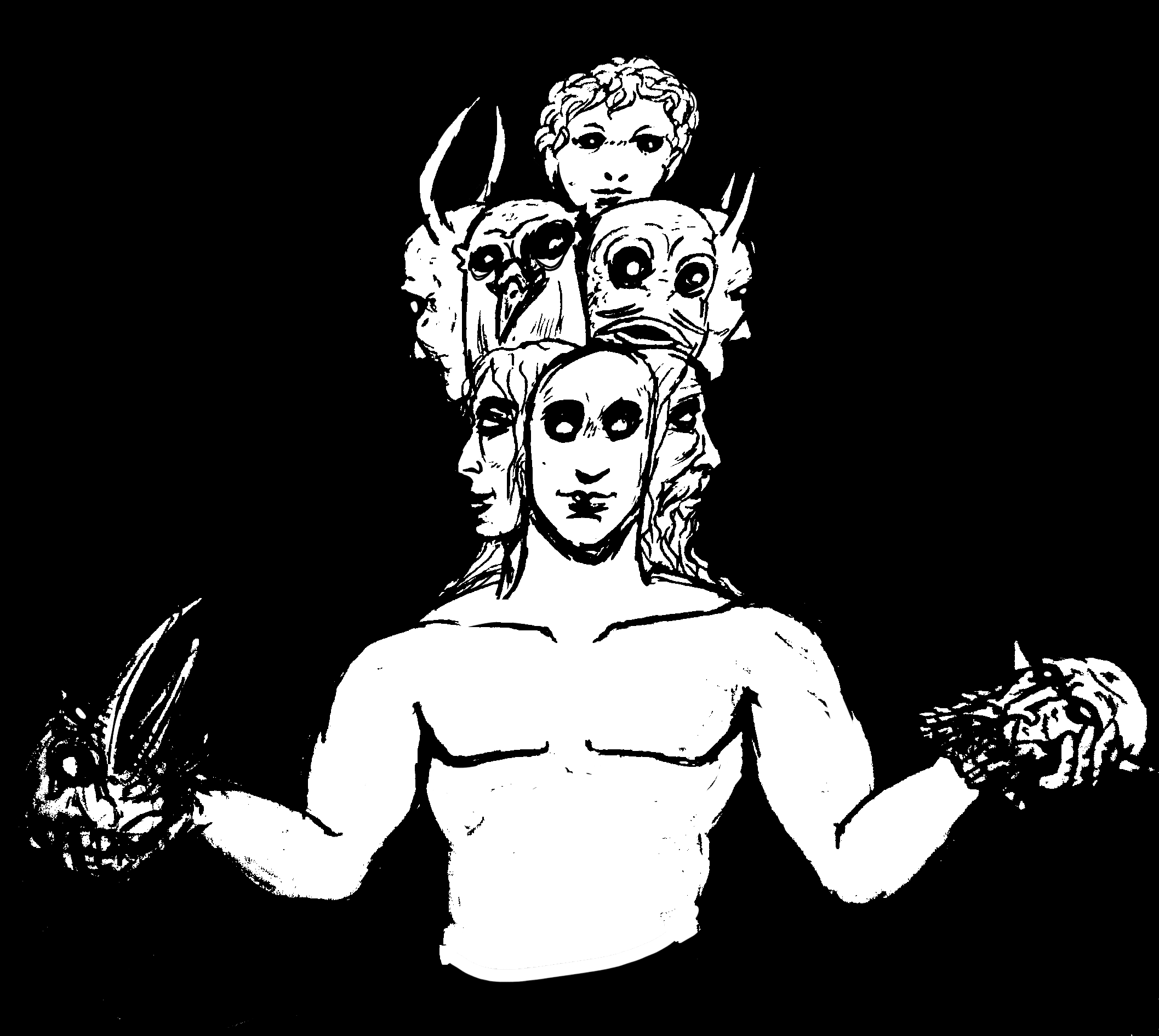
The popular conception of contemporary Paganism is a polytheistic religion oriented around multiple Gods that holds a deep reverence for the earth and has a connection to some sort of ancestral lineage. Often, there is also a connection to esoteric ideas like witchcraft, the runes, or perhaps tarot. However, this explanation is simplistic and ignores many realities about the thought landscape of contemporary Paganism. This religion is not truly a single religion at all—Paganism is merely a broad tent label for a collection of many faiths, often faiths that are theologically disparate and contradictory. There is no one Pagan movement, no single Pagan religion, and there is one key theological schism that upholds this reality: the distinction between so-called hard polytheism and soft polytheism.
To begin this conversation, and explore this chasm of contrasting beliefs, it must first be understood that this language, these terms, are contemporary. In the ancient world, this phrasing was never used, not once. Though you do see this discourse pop up in theological discussions and esoteric conversation, it was not brought up inside of this framing. Individual Pagans in antiquity did not identify with being either soft or hard polytheists; many lay Pagans likely never even questioned their conception of divinity in the way that this question does. After Paganism fell, and monotheism overtook the world, such discussion was brought up in critique of Pagan thought, yet once again, this language of soft versus hard polytheism was not utilized. This is modern language for an ancient conversation.
In tracking down the origins of this rhetoric, it appears as if the first published utilization of this language was in a 2011 academic paper entitled Seeking the Mystery: An Introduction to Pagan Theologies by Christine Hoff Kraemer. This paper explores the many different theological expressions of the modern Pagan community and outlines clear definitions of these terms. However, prior to this, it is clear these terms were utilized and understood. It appears as if the earliest known public social media post that uses these terms is a 2007 thread of ReligionForum.net. Though, in the responses to this post, people did know the term, meaning that it was in use, even if among a niche community, prior to this date. By the 2010s, there were countless blog posts, articles, and forum threads exploring this topic and using this language. By the present time, this language has appeared in many published books on Pagan thought and belief, both in the practitioner-driven mind, body, and spirit space, and in the scholarship-driven religious studies space.
The definitions of these terms are relatively straightforward, so much so that they can actually obfuscate the topic further. The common definition is as follows: soft polytheism argues that the Gods are all faces of one singular divinity; whereas, hard polytheism argues that all of the Gods are entirely separate beings. There is a glaring problem here: not all polytheistic systems cleanly fall into these two categories that this dichotomy presupposes applies to all Pagan thought. The most glaring example is Wicca. Within Wiccan thought, there is a God and Goddess. Every Goddess is a different face of the Goddess, and every God is a different face of the God. These two forces are entirely separate, marking it as hard polytheism, but at the same time, this also supposes that Diana and Venus are one, which would make it soft polytheism. What becomes of Wicca? It all collapses. Furthermore, how would this conversation apply to grey area Gods? For instance, Al-Lat, Al-Uzza, and Manat of Arabian Paganism are defined as separate Goddesses, but are often brought up together, under one title, the Ghanariq (translation from Arabic: “The Most Exalted Cranes”). This does not apply to all the Gods of that religion, though; figures like Hubal, Allah, and Shamash never appear in a composite form like this.
Still, even though this language collapses when applied to some traditions and deities, it does refer to a real theological distinction that shapes the way a practitioner relates to the Gods. The most obvious gap is ritual expression. Many soft polytheists will utilize multiple names for the same God in their rituals. In certain soft polytheist invocations and hymns, you will even see long lists of names of a specific God used as one invocation. In hard polytheist thought, this language is never used; it can even be seen as blasphemous. One argument that is thrown around by hard polytheists is that saying the wrong name for a God is equivalent to calling your wife the wrong name in bed. The thing is, even though modern Pagans invented this conversation under these framings, it is an ancient one.
In the modern community, there are sects of Paganism that tend to be more associated with hard polytheism, and other sects more associated with soft polytheism, respectively. Generally, it is presumed that reconstructionists, or people trying to completely recreate the ancient expression of these beliefs, will be hard polytheists. It is also generally assumed that people who follow Pagan traditions that are more explicitly syncretic or unique to modern times are more likely to be soft polytheists. While there are some systems that explicitly obligate a practitioner to hold a specific stance on this conversation—for instance, it is impossible to be a Thelemite and a hard polytheist—this is an oversimplification not based in truth. Ironically, soft polytheism is expressed more consistently amongst ancient thinkers than hard polytheism. Notably, Plato believed in soft polytheism, and wrote: “We must assume a single principle of limit and of the unlimited… From these arise all the things that are.” The modern Platonic Polytheist landscape is made up nearly entirely of soft polytheism. Though, in antiquity, soft polytheism was not a consensus. Sallustius, a Pagan writer in the fourth century, was a staunch critic of soft polytheism and wrote: “Each God rejoices in the name which accords with his own power, and to confound the names is to confound the natures.”
This cuts to the core of the conversation—the nature of God. The thing is, Paganism is that: a religion. There is a common rebuttal to this, that Paganism is an orthopraxy, or practice-based individualistic belief system, not an orthodoxy, a creed-defined collective belief system. However, if we look before the Pagan revival, that falls apart. Paganism was the religion of states, of empires. It was clearly defined, and despite this claim, the sculptors of modern Pagan thought, even in the most Neopagan of all sects, cared about theology. Aleister Crowley’s Thelema, which is so far in the Neopaganism camp that it calls itself the religion of the New Aeon and frequently spouts individualistic sentiments, has a clear interest in theology. Even in the system of individual Will, which spits on older traditions, has some orthodoxy. Wicca has a clear theology, a clear duotheism. Modern Druidry, which has a lot of modern theological influence on it, as few Druidic sources have survived, teaches a theology. Even if a system is an orthopraxy, or allows individual practice and individual expression, it must be concerned with some sort of orthodoxy. If there is no reason why something is done, or no understanding of what a God is, no theology, a system is not a system; it is a label. It is simply nothing.
How a practitioner understands the Gods is tantamount to how they progress. After all, when a practitioner is engaged in religious devotion or mysticism, they have a goal, an end result. If a practitioner is a soft polytheist, their aim changes compared to a hard polytheist. For a soft polytheist, the likely goal of their theurgy is unification with the Godhead. For a hard polytheist, their likely end goal is to get closer to a particular God or prepare for a specific destination in the afterlife, such as Valhalla. This end goal gap changes the entire course of action for a mystic’s devotion. For a soft polytheist, ideas such as annihilation and surrender are paramount. For a hard polytheist, ideas such as devotion and worship are of the utmost importance. It changes everything. For people who exist in the grey zone between these theologies, such as Wiccans, there will be variance in what the goal is.
Within Pagan religions, Gods rule over specific topics, subjects, and themes. For instance, Aphrodite is a Goddess of love, sexuality, and war; whereas Apollo is a God of poetry and the Sun. Depending on how a Pagan approaches the nature of their Gods, the way the God relates to these themes radically shifts. From a hard polytheist vantage point, each God is the literal ruler of these themes. From a soft polytheist perspective, as the Gods do merge into one singular Godhead above a certain threshold of divine existence, this dynamic changes. If you look deep enough, since all is one, all things relate to all themes. Technically, Aphrodite, despite being a love Goddess, above a certain point is also tied to storms, intellect, and death. Still, soft polytheists, in their day-to-day practices, do not use the name Aphrodite to explore grief and loss—why?
Within soft polytheism, despite this paradigm holding the belief that all Gods are one, there is still a belief in separation. Consistently, the harshest critique against soft polytheism has been that, at that point, why would one not just embrace monotheism? Christian theologians have used this argument repeatedly, pointing out that these Pagans are Christians, but stubbornly refuse to convert. Augustine of Hippo argued, “Those who say that many gods are parts or powers of one god are in truth confessing one God, though they blush to name Him.” Thomas Aquinas argued in Summa Theologiae, “If many beings are called gods insofar as they participate in one divine nature, then they are not gods essentially but by participation; and thus there is but one God essentially.” There are even some Christian writers who have asserted that the soft polytheists of antiquity, namely the Platonists, were different from other Pagans: they were misguided Christians, and even coined the term “Virtuous Pagan” to justify this. This gives their real motivation away. Despite this being an argument used to convert soft polytheists, it cuts to the inner truth: Christian theology is influenced by Platonic Polytheism, not the other way around. To admit that Pagan philosophical thought has shaped and molded Catholic thought, including the mind of Thomas Aquinas, shakes the foundations of monotheism. It is easier to go the other way.
While many may reject the supposition that Pagans are the Hindus of the East, and for good reason, that opinion is vastly oversimplified, it is worth looking at Hindu theology. Hinduism, unlike Paganism, never broke its lineage. While many Pagan sects argue that their religion continued on from antiquity within secret cults and simply re-emerged when it was safe to, there is scant historic evidence to this claim. As well, even if such claims are true, which they may well be, even if evidence is sparse, these cults were disorganized, disparate, and secret. While secrecy has immense mystic value and amplifies the power of initiations, it does mean it is easier to lose information on what a sect believed. Thus, even if Paganism survived in the remote woods of Europe, its centralization, theologians, and institutions did disappear. This makes Paganism, in all its forms in Europe and the Near East, a broken lineage. Hinduism did not experience such a break; it continued on. To this day, Hinduism is the largest polytheistic sect in the world and is largely soft polytheist.
Hinduism believes in countless Gods. There are Gods that are widely popular and govern entire sects, such as Shiva and Krishna, but there are also Gods only known in small villages. Hinduism does not deny any of these Gods, and controversially, many modern Hindus argue that Pagan Gods exist and are simply the Gods of the West. Hinduism, though diverse in its beliefs and views, is largely a soft polytheist system. Modern Hindu teacher Swami Vivekananda said, “Hindus never worship idols. They worship God through idols. The different gods are different manifestations of the same God.” This is as explicit as it comes. Edward Butler, a modern scholar on both Pagan traditions and Hindu faiths, provided in an essay he wrote on this subject called “Polycentric Polytheism” a clear comparison and bridge between these belief structures. Before reading this excerpt, please note that panta-en-pasin refers to the God in all, or soft polytheism:
“Both panta-en-pasin and the metaphor of Indra’s net express the concept that individuality implies relation, but in a surprising way. Relations are not something external added onto individuals; instead, relations are in individuals in some fashion—relations with other things are the presence of things themselves in one another […] Moreover, if we are really to appreciate the metaphor, then we must assume that there is no point of view on the whole net other than the reflections in each jewel. The jewels are not merely perspectives on the totality—rather, the universe itself is nothing other than these myriad perspectives. We may take any jewel, at any time, as the center of the net, and plot the whole system of relations starting from it and ending with it. Compare this idea with the formula, preserved for us in the medieval text Liber XXIV philosophorum (but perhaps of ancient pedigree) that speaks of the divine (‘God’) as ‘a circle whose center is everywhere and its circumference nowhere.’”
This cuts to why soft polytheism believes in one God, but it is not the same as monotheistic religions, such as Islam or Christianity. The jewels, or separations, matter. Despite all being part of one singular divinity, there is separation, there is distinction, and these distinctions matter. This is easier to understand when more extreme forms of soft polytheism come up. Many soft polytheists are also animists, or people who believe everything has a spark of divinity, a soul, within it. In this schema, everything is part of God, yet it would be absurd to not acknowledge separation. At the end of the day, the coffee cup and the dog are part of one divine being, yet it would be comical to call the dog a coffee cup. This is where it divides from monotheism.
Monotheism, despite believing in one God, typically does believe in separation. In Christian theology, separation is often tantamount to understanding how the cosmos works. Catholic theology, for instance, is highly hierarchical. Animals are under the domain of humans, and humans are under the domain of God. There is no implication these are one; they are separate. Furthermore, the angels, despite not possessing free will, are not part of God, not part of Christ. The same logic applies to the Saints and Mary, though some sedevacantists may heretically insist otherwise. This logic shows how, despite believing in one God, when the rest of the theology is examined, most monotheistic traditions are, ironically, closer to hard polytheism.
Despite this paper spending more time on soft polytheism, as it is the most misunderstood theological stance, this does not mean that hard polytheism lacks theology. Hard polytheism’s theology is complex, rich, and ironically more divergent. Each Pagan system that embraces hard polytheism has a radically different theology, a radically different relation to the Gods, and a radically different view on the end goal of devotion. Nordic Paganism, in particular, has the highest rate of hard polytheist adherents, and even within the Nordic Pagan umbrella, there are entirely different religions. It is not unheard of for a practitioner of Ásatrú to be hostile to a practitioner of Thursatrú, as their specific deities within the Nordic Pagan world are adversarial. It is impossible to explore, in one singular article, the many theologies of hard polytheism, as they are less unified in their philosophical understanding of the nature of God, as they are truly all unique religions.
Despite this conversation being, on the surface, a schism between Pagan sects, it shows the truth—there is no one Paganism. Paganism, as a term, is merely an umbrella label for a vast set of different faiths. This conversation will remain divisive and controversial, as it reflects a theological crevasse more extreme than that between Catholicism and Protestantism. In reality, Paganism is not one thing at all; there are as many Pagan sects as there are many Gods.
If you enjoyed this article, please consider supporting Katharsios Press by purchasing a print copy of one of our books on www.katharsiospress.com. Our manuscript sales allow us to properly pay and acknowledge our contributors. As well, you can make a one-time donation through https://buymeacoffee.com/katharsiospress and a recurrent donation by subscribing to the Katharsios Press Substack. Please help us further the discussion of esoteric topics, outside of the creative constraints imposed by the academic world.
CITATIONS:
Augustine of Hippo. The City of God. Translated by Henry Bettenson. London: Penguin Classics, 2003.
Aquinas, Thomas. Summa Theologiae. Translated by Fathers of the English Dominican Province. New York: Benziger Bros., 1947.
Butler, Edward P. “Polycentric Polytheism.” Essays on the Metaphysics of Polytheism, 2015.
Crowley, Aleister. The Book of the Law (Liber AL vel Legis). York Beach, ME: Samuel Weiser, 1976.
Kraemer, Christine Hoff. “Seeking the Mystery: An Introduction to Pagan Theologies.” Journal of Contemporary Religion 26, no. 3 (2011): 357–372.
Plato. Philebus. Translated by Dorothea Frede. Indianapolis: Hackett Publishing, 1993.
Sallustius. On the Gods and the World. Translated by Thomas Taylor. London: Prometheus Trust, 1993.
Vivekananda, Swami. The Complete Works of Swami Vivekananda. Vol. 1. Kolkata: Advaita Ashrama, 1989.
