Agape Within The Framework of Thelema
Authored by Elias Vingre, Art by Nadia Zaranska, & Edited by Georgina Rose
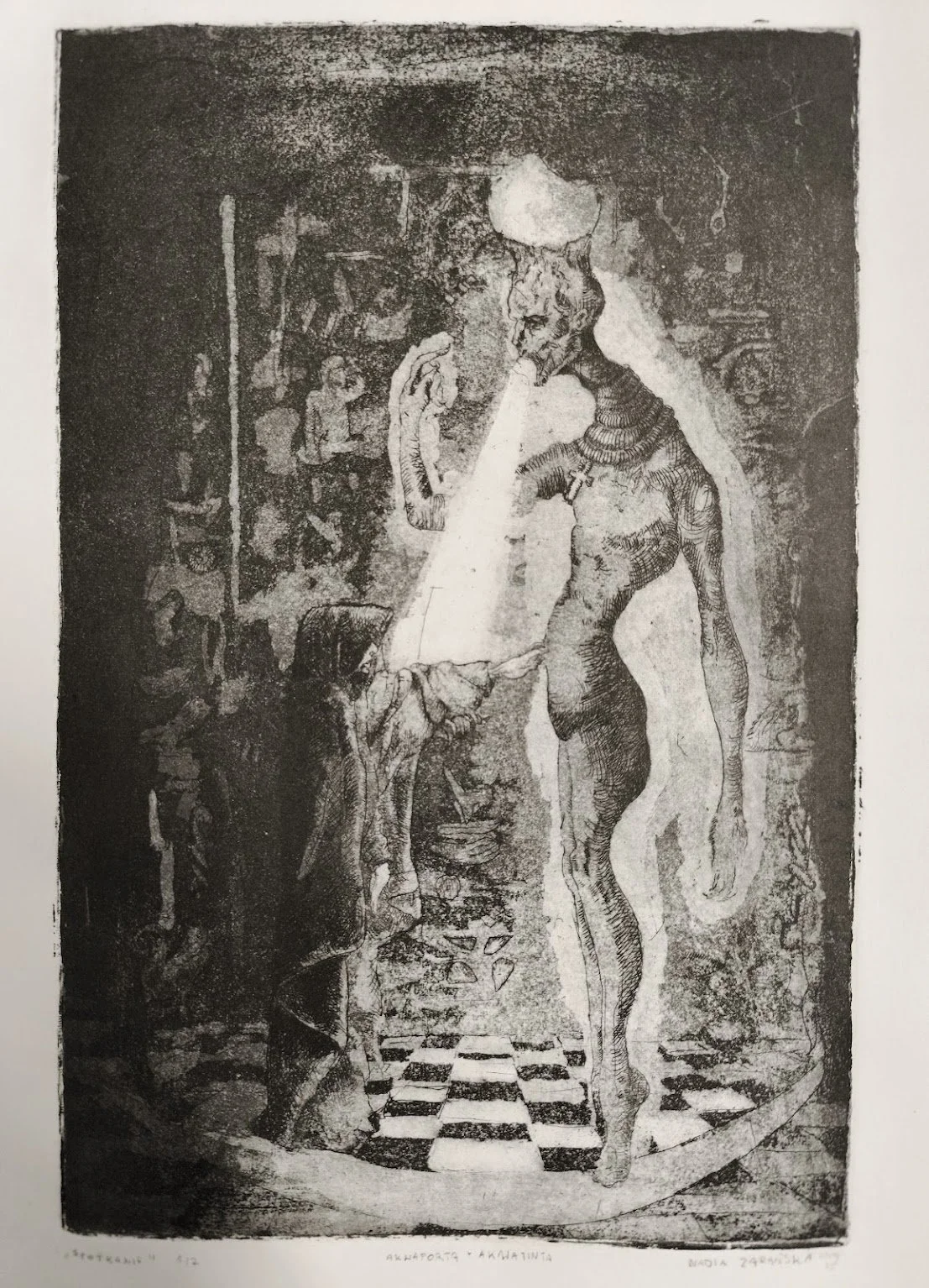
The concept of “Agape” cuts straight to the heart of the esoteric mysteries, unveiling the truths of the sacred arts in one single word. This term can be defined as a form of Love that transcends transactional, physical, and familial relations. Within the current of Thelema, an esoteric and philosophical system established by Aleister Crowley in the early 20th century, Agape has assumed a pivotal role. Thelema centres on the principle of Will (‘Thelema’ in Greek). This relationship is encapsulated in the maxim, “Do what thou wilt shall be the whole of the Law.” After this, there is a second statement, “Love is the Law, Love under Will”. In this phrase, Love does not refer to all forms of Love, it does not reference Eros, Philia, or Storge, it explicitly means Agape. In this axiom, Agape can be understood as not a mere sentiment, but a fundamental cosmic principle that governs and harmonises the True Will. It embodies the living law that animates the Thelemic practice, underscoring Love as both the origin, and outcome of spiritual sovereignty and liberation from the bounds of the human body.
The concept of Agape is deeply syncretic, grounding itself in all forms of Western spiritual thought. It was particularly fleshed out as a concept within early Christian mysticism, where it was articulated as the highest form of divine Love. Early Church Fathers and mystics described Agape as self-giving, sacrificial Love that reflects the nature of God and the ideal human relationship with the divine and others. This understanding of Love as transcendent and unconditional was further shaped by Neoplatonism, which emphasised the unity of all beings through a divine source, and Hermeticism, which explored the interconnectedness of the cosmos through spiritual knowledge and alchemy.
In Thelema, a system that is downstream of this western esoteric lineage, Aleister Crowley developed draws heavily on these esoteric traditions, synthesising and reinterpreting them within a contemporary occult framework. Crowley incorporated Agape as a central tenet, elevating it to a principle that complements and governs Will. In The Book of the Law (Liber AL vel Legis), Agape is not only as Love but also as the “law”, the dynamic force underpinning the exercise of True Will. Following, the logic of Will being Thelema and Love being Agape within the phrase “Love is the Law, Love under Will.” This integration could reflect Crowley’s vision of a spiritual path in which Love and Will are inseparable, each informing and empowering the other in the quest for individual and cosmic liberation. They guide the practitioner into the Great Work, the ascension into the Godhead.
Agape, understood as divine, unconditional Love, functions as an essential balancing force to Will within Thelemic philosophy. While Thelema emphasises the primacy of individual Will, it is Agape that governs, harmonises, and animates the Will. This ensures it manifests in virtue rooted in unconditional devotion to the divine, rather than unchecked desire and hedonism. This examination is especially relevant for contemporary Thelemic practitioners who seek to deepen their understanding of Thelema, beyond the common misconception of Thelema being mere individualism. This allows them to embrace a path in which Love and Will coexist as transformative interdependent forces that guide them to the Great Work.
Gematria, a numerical interpretive method rooted in Kabbalistic and Hermetic traditions, assigns numerical values to letters, which reveals hidden relationships between words and concepts. Aleister Crowley adopted this technique, particularly using Greek isopsephy, to deepen the symbolic fabric of Thelema. The words ‘Agape’ (ἀγάπη) and ‘Thelema’ (θέλημα) both total 93 in gematria. This shared value is emblematic of the inseparability of Love and Will in Thelemic cosmology.
Beyond this overlap, the interlacing esoteric nature of these concepts appear in many areas of the Thelemic system. The Goddess Nuit, the infinite Goddess of the starry cosmos, and the God Hadit, the Zenith God of individual consciousness, also connect symbolically to this framework. Their relationship illustrates cosmic interplay where Agape and Thelema serve as complementary forces guiding towards the Great Work. The Gnostic Mass, written by Crowley in 1913, is the central ritual of the Ordo Templi Orientis (OTO), and serves as a liturgical expression of Thelemic cosmology. Agape is invoked in it as the sacred Love that unites the congregation with the divine. This hereby symbolises spiritual communion and the sacred unity of opposites. The ritual’s language repeatedly affirms Love as the binding force: “Love is the Law, Love under Will.” The resonance of Agape sounds all throughout this sacred rite.
In magickal practice, Agape is an active, generative force that empowers the magician’s Will, while allowing them to maintain an alchemical balance. This principle is often symbolised by solar imagery and the flaming heart, representing divine Love as both illuminating and transformative. Thelemic art and iconography frequently invoke this depiction of Agape through these symbols, even in subtle forms. For example, the flaming heart motif appears in OTO regalia and ritual tools, visually embodying the concept of sovereign Love. In The Book of the Law, Agape is proclaimed as the law itself, a cosmic principle that governs the expression of Will through Love. The phrase “Love is the Law, Love under Will” encapsulates the mystical synthesis at the heart of Thelema. This invites practitioners to embody a conscious, sovereign Love towards the Gods that harmonises with their True Will.
Crowley’s later works, including The Heart of the Master (1918) and Magick Without Tears (1954), further explore Agape as a creative, redemptive energy essential to spiritual development and magickal effectiveness. He emphasised that Love in this context is not sentimental, but an active force of transformation and unity. Contemporary Thelemic scholars such as James Lees and Lon Milo DuQuette have also interpreted Agape as proof that those who reduce Thelema to mere egotism are woefully misinformed. They stress this wilful Love’s role in grounding Thelemic practice in ethical sovereignty and spiritual unity. This makes it indispensable for modern practitioners seeking a balanced path on their way to ascension. Agape is more than an abstract ideal in Thelema; it is a living force to be actively cultivated.
Many practitioners may engage in meditation and visualisation techniques aimed at awakening this divine Love within themselves. For instance, Crowley recommended meditating on the solar heart, which is a symbol of Agape. To do this meditation, a practitioner visualizes a radiant flame at the centre of one’s being that slowly expands outward, eventually embracing all of existence. This practice fosters a direct experience of Love as a sovereign, generative power, rather than mere sentimentality. Daily Thelemic observances often include the conscious repetition of the Law: “Love is the Law, Love under Will.” This is performed with the mindful intention to align one’s actions with the harmonising principle of Agape.
The Gnostic Mass, a ritual central to many Thelemic communities, embodies Agape as sacred, transformative energy, inviting participants to experience Love as a unifying force that transcends duality and fosters spiritual communion. True Will, the unique purpose that the individual experiences throughout their entire incarnation, is the cornerstone of Thelemic philosophy. However, without the balancing influence of Agape, this Will that hasn’t walked the synthesis of Love risks devolving into egotism or harm if unchecked. This is the consequence of simply Doing What Thou Wilt without doing it with Love for this divine path the Gods have set out for us.
Agape’s universal resonance offers fertile ground for dialogue happening between Thelema and other esoteric and spiritual traditions. Comparative analyses could even reveal parallels between Thelemic Agape and concepts such as unconditional Love in Christian mysticism, compassion in Buddhism, and divine Love in Sufism. This provides glimpses of insight into the perennial truth that underlies all of the world’s traditions. These intersections can create opportunities for interfaith collaboration, fostering mutual understanding and shared spiritual practice grounded in Love as a transformative force, while following their own unique Will. Synthesising these perspectives can enrich Thelemic praxis, encouraging practitioners to engage with broader spiritual currents in a perennial manner, while maintaining the distinctiveness of Thelema.
Despite its centrality, Agape remains underexplored in academic and esoteric scholarship relative to other aspects of Thelema. Yet, here we have traced the multifaceted dimensions of Agape within Thelemic philosophy—from its ancient and esoteric origins to its profound symbolic resonance and practical applications in contemporary spiritual praxis. Historically, rooted in divine Love traditions are reimagined by Aleister Crowley as a cosmic principle inseparable from Will. Agape emerges as the vital force that balances, animates, and elevates the law of Thelema. In embracing Agape, Thelemites can reclaim a profound source of liberation and unity, transforming Will from mere assertion into a harmonious embodiment of Love and purpose that can illuminate both individual paths and the wider world within the greater scheme of our individual and collective Great Work.
