Spiritual Considerations Of The New Psychedelic Renaissance
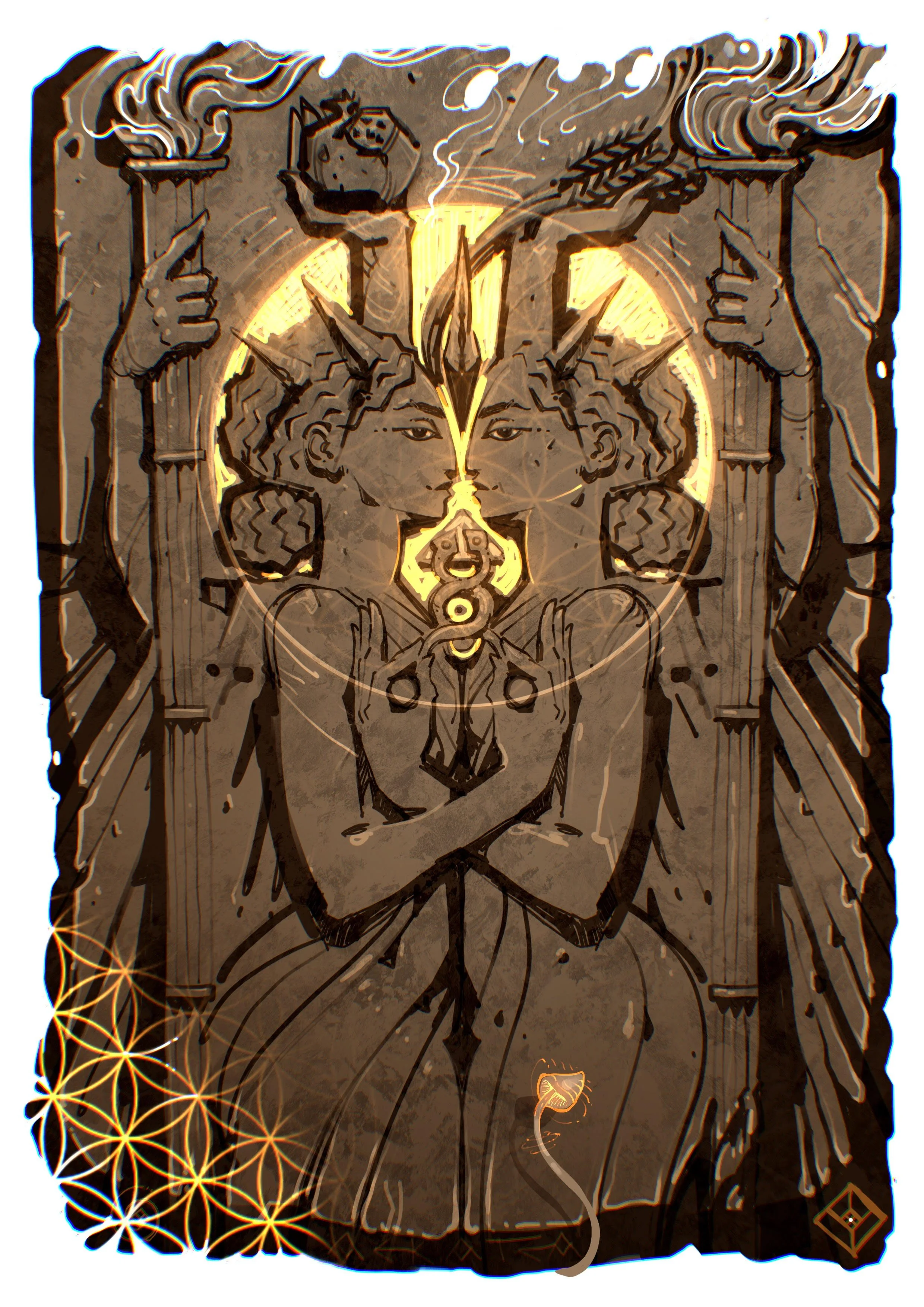
Writing by Vince McLeod, Art by Nightgrowler, and Editing by Georgina Rose.
In 2026, the world is psyched to embrace the power of psychedelics. Every few weeks, a major new study comes out suggesting psychedelics may be useful for depression, anxiety, post-traumatic stress, or some other condition. The evidence has risen to such prominence that there are now entire academic journals solely devoted to the research and development of psychedelic medicine (1). As this interest in medical psychedelics grows, it is clear to see that interest in non-medical uses will also grow. This includes recreational use, but it without a doubt will also include spiritual use. Despite the high-tech associations of the new psychedelic renaissance, their use as spiritual sacraments is about as old-fashioned as it gets, and will not be forgotten.
The use of psychedelics in spirituality is so far from new and it can be argued it was once central to Western civilisation. From the centuries before Homer and until their destruction at the hands of Theodosius in 392, the Eleusinian Mysteries took place in Eleusis, a day’s walk outside of Athens. These Mysteries were, exoterically, an annual festival in honour of Demeter and Persephone, that recounted Persephone’s abduction by Hades. Esoterically, they involved a powerful spiritual formula that transformed participants in a way they were immensely grateful for. The precise nature of this formula is unknown today, because participants were sworn to secrecy, but we have several clues.
These participants included many of the most prominent members of ancient society. Plato, Euripides, Aeschylus, Sophocles, Aristophanes, Augustus, Cicero, Hadrian, Marcus Aurelius, Julian, and many others were known to, or at least credibly speculated to, have partook in them. Socrates, notably, refused to engage with them, on the grounds that he did not want to be bound by an oath of secrecy. On the Mysteries, Pindar wrote: “Blessed is he who sees them and goes beneath the earth; he knows the end of life and knows its Zeus-given beginning (2).” After mystically knowing the end and re-beginning of life, participants came to no longer fear death in the ordinary manner. It healed one of the most powerful fears and wounds of all, through the power of the mysteries.
The peak of the rituals of the Eleusinian Mysteries took place in a particular building called the Telesterion. Here, participants were given a strange beverage known as the kykeon, famous for inducing powerful visions. Researchers such as Terence McKenna, R. Gordon Wasson, and Carl Ruck believe that the main psychoactive ingredient in kykeon was psilocybin mushrooms. Their reasoning is that psilocybin mushrooms are known for inducing visions that can cause a person to lose their fear of death, which was the purpose of this journey. As well, the kykeon did not have a reputation for poisoning or harming people, and psilocybin mushrooms are known to be relatively safe. Apart from psilocybin mushrooms, all other drugs powerful enough to produce such profound and intense experiences are too harmful to give to several thousand people at once without poisoning at least a few, which rules out other known entheogens, such as amanita muscaria or datura. Due to the power of these rites producing a large number of people unafraid of death, Greece and Rome were able to reach their powerful spiritual and cultural peaks. They have still, thousands of years later, yet to be surpassed in their influence and reach.
Modern Westerners are in the process of rediscovering this spiritual tradition. Ongoing psychedelic experimentation will eventually bring back similar insights to those gained by participants in the Eleusinian Mysteries. These insights will become more popular as awareness spreads of the psychological benefits of psychedelics. This will, over time, lead to something like the Eleusinian Mysteries re-establishing themselves. As such, a sober examination of the benefits and dangers of psychedelic use for theurgy is timely.
The word “psychedelic” was coined by British psychiatrist Humphry Osmond to mean “soul-revealing.” His observation was that many people, assuming themselves to be their bodies only, did not know they had—or were—souls until a psychedelic revealed it to them. This sort of experience has been reported by many who undergo psychedelic journeys. In many cases, a person thinks they are their body their entire life, up until the peak of a psychedelic experience, at which point they realise they are consciousness inhabiting a body, and not a body manifesting consciousness.
Realising they are consciousness, a person then realises that they will survive the death of the physical body. If the physical brain does not generate consciousness, then the death of the physical brain cannot destroy consciousness. From there, it is natural to come to believe in an afterlife, reincarnation, God, karma, theurgy, magick, and the rest of it. A psychedelic, in revealing a person’s soul to them, can transform them from a non-spiritual into a spiritual person. This transformation is so profound it is arguably more profound than birth or death. You are born once and die once per life, but you might go a million lives without realizing that you are consciousness—eternal and immaculate.
It is here that the Great Work begins for many people. In recognition of how psychedelics can be so powerfully life-altering, a person was only allowed to partake in the Eleusinian Mysteries once in their life. More than once was viewed as unnecessary, perilous even. In this sense, skillful use of psychedelics has always been more like acute medicine than chronic medicine. It is most like giving an antidote to a poisoned person, done in a moment of vital need.
For these reasons, psychedelics are not something one must take frequently, like headache pills or other everyday medicines. It may be that a person needs to take them more than once to really understand, or that they may need to take a variety of different psychedelics over time before it all sinks in. It is also common for a person to understand initially, then forget over time as the sensory impressions of the material world slowly overwhelm them, and to need a refresher. In this regard, Alan Watts gave the best advice: “When you get the message, hang up the phone (3).”
What is necessary, then, is to do all the spiritual work. A psychedelic can cure you of the curse of materialism, but it cannot do theurgy for you. Imagine wandering, lost, in a dark forest. The path is rocky and slippery, with many cliffs. You are terrified of wandering off it and dying. Along the edge of the path, you find a magic fountain and take a drink from it. You feel lightheaded.
You begin to float. Rising high out of the dark forest, the environment brightens all around you. You can now see that the forest is on the side of a mountain ten times higher than Everest. The path winds through this gigantic forest up the mountainside, all the way to heavenly fields of light at the top, full of friendly beings of all kinds—family from past lives, entities from higher realms, everyone that is good from all possible dimensions. You realise that this is your true home and your inevitable destination, and that all is good, all is perfect.
Then you float back down beside the magic fountain. You still have to walk out of the forest. You still have to do all the donkey work of putting one foot in front of the other a million times and navigating all the traps and dangers along the way. But now you have faith in the benevolence of both the process and the final result. You know you will succeed and that all is well.
Psychedelics are much like this. You can temporarily feel as though you are having an out-of-body experience, but you must return to your physical body, and live out its allotted lifespan. The difference is that now, knowing the final result is good and that all suffering is temporary, you will suffer far less than you otherwise would have when you believed life was a desperate material struggle to postpone death and dissolution for as long as possible. Now you believe in a higher purpose, and that belief dissolves existential depression and despair.
There are a minority of people who, after taking a psychedelic and meeting God, assume the process of theurgy is complete. Absent for a moment from existential despair, they believe all misery is behind them. This is a common pitfall. On one level, everything is indeed sorted. A person now understands why Eckhart Tolle said, “There’s a goodness present that pervades the entire universe (4).” But on another, more practical level, there is still immense work to be done. One must discover every aspect of the psyche, accept or overcome those aspects, and integrate them into a cohesive whole—and that is only the beginning.
Trying to develop spiritually by taking psychedelics without meditation is like trying to build muscle by eating protein, but failing to ever lift weights. A psychedelic may show you the rewards of ataraxia and reveal how unhappy people are when they never examine their minds, but your habits and character were formed long before this awareness arose. Spiritual advancement still requires breaking these patterns down and rebuilding them in higher forms. Once awakened to spiritual reality by psychedelics, a person must still do all the meditation. This is not a shortcut, the same amount of work is still required. The difference is the motivation to do the Great Work. Beforehand, spirituality may have seemed absurd or foolish. Only after the soul has been revealed can a person feel compelled to purify it or raise its frequency.
If an intelligent and informed person were to design a plan for spiritual psychedelic use today, it might look something like this: First, ensure you are in the right headspace for a monumental psychic shock. Do not take psychedelics while preoccupied with stressors like exams, funerals, or surgeries. Preparation helps, even if total preparation is impossible. Reading texts such as: “The Tibetan Book of the Dead”, “The Doors of Perception:”, or Timothy Leary’s “The Psychedelic Experience” is highly beneficial. They can help you gain, at least, a little bit of a sense of what is about to come.
Second, choose a setting free from disruptive energy. Psychedelics are no different from any other spiritual practice in this regard. A peaceful, rural environment with trusted friends is ideal. Maximise beauty and minimise ugliness in sights, sounds, and smells. Psychedelics may be considered a form of theurgy for beginners. They do not complete the Work, but they reveal its true meaning. For skeptics or those stalled in their esoteric practice, they may demonstrate that immense joy lies in a shift of spiritual perspective.
By 2026, it is now understood that psychedelics are far less dangerous than once believed. As stigma fades, interest grows. The best advice may come from Terence McKenna: “Take it easy, but take it.” In other words, do not obsess—but do not underdose. You will only have one first psychedelic experience.
If you would like to support the continuation of work from Katharisos Press, please consider donating to our journal or checking out our full length books in our shop.
References
(1) https://home.liebertpub.com/publications/psychedelic-medicine/673//overview
(2) https://www.loebclassics.com/view/pindar-fragments/1997/pb_LCL485.385.xml
(3) https://www.amazon.com.au/dp/1608682048
(4) https://www.eatonsatsang.com/copy-of-quotes
