Remembering Gardening As Magickal Animism
Article by Benjamin Galindo, Art by Staci MC, & Edits by Georgina Rose.
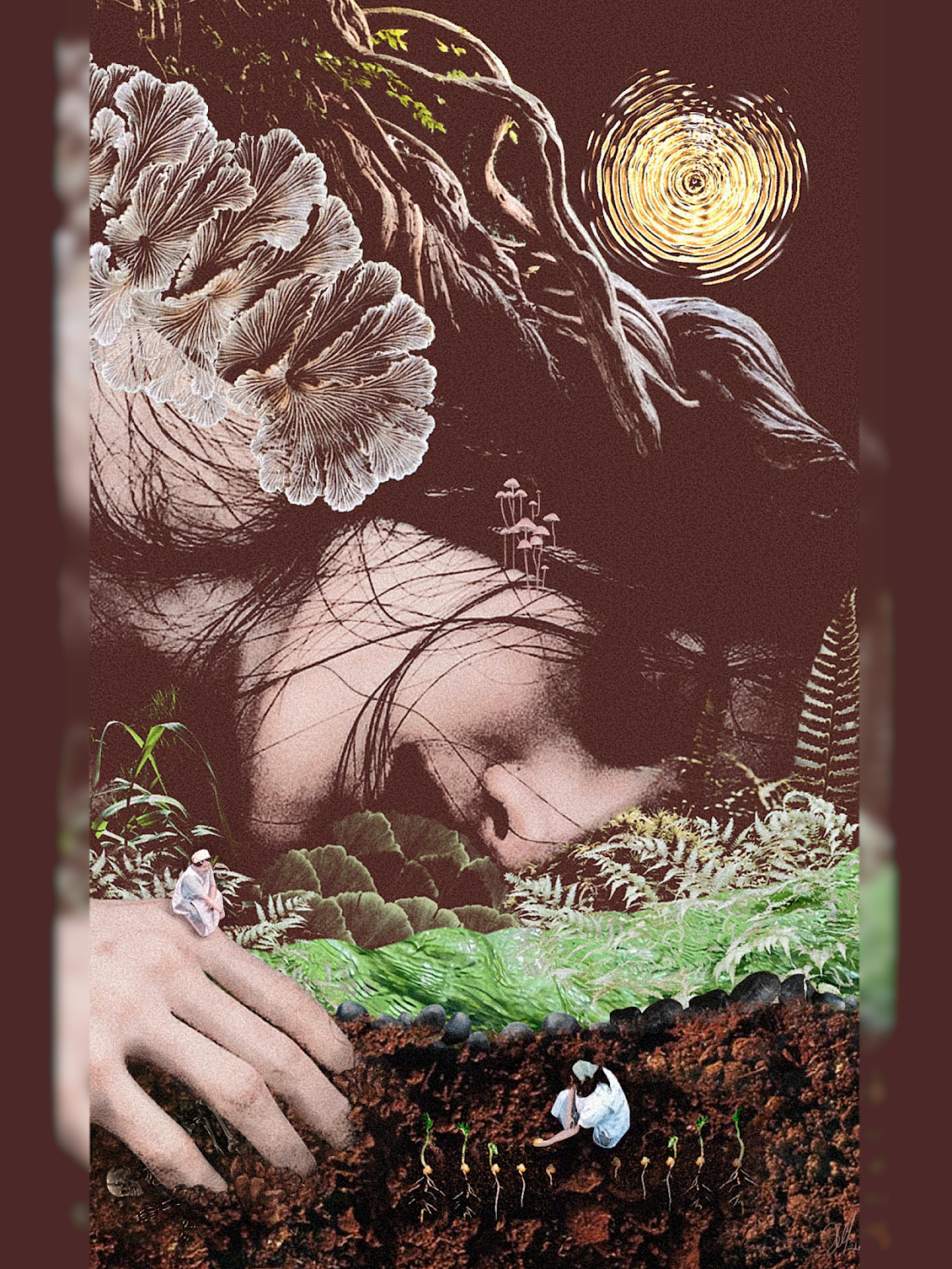
A garden isn't just a collection of plants, just as you are not merely a collection of cells. Instead we should view both as relational sites of convergence where physical and subtle (i.e. 'spiritual') forces come together to play. The original altar was the soil. Gardening is one of the oldest forms of magickal practice, predating grimoires and the codified ceremonial systems we consider as tradition. The simple acts of planting, tending, harvesting, and returning matter to the earth constitute a complete ritual system that reorients the gardener within a living, breathing, greater-than-human world.
We all know plants hold important correspondences as altar offerings, in incense or smudges, and in spellwork in general, but growing and tending to them in direct relationship deepens your attunement to their subtle energies and spirits. Working in a garden is an ancient esoteric praxis that connects you to a primordial energy more powerful than any technology or machine created by humans.
After understanding these truths, at the end of this article, there is a ritual to follow that is based on traditional cord cutting rituals you are likely already familiar with, but with an Earth magick twist.In this ritual we will partner with living Earth energy, harnessing the ancient gardening technology of composting, to transform our unhealthy attachments into regenerative fertility.
Indigenous Animist Roots
So how exactly is gardening an esoteric art that can connect us not only to the plant kingdom, but to natural elements and forces as a whole? To answer this question, we must first remember gardening as an animist practice. Animism is the understanding that personhood, agency, and spirit extend beyond the human into plants, animals, stones, waters, and weather. It is not merely a primitive stage of spiritual evolution we outgrew. Animism relocates humans as embedded within a larger community of living, nonliving, and nonphysical entities and forces that affect our world. Everything is vibrating, everything is sacred, and as David Abram's argues, "All things have agency, the capacity to act"1.
This relational cosmology is arguably the most persistent metaphysical orientation humans have ever held, arising independently in societies on every inhabited continent. It endures into the present day wherever people remain in direct, consistent relationship with the land that sustains them. Pre-modern peoples tracked the stars because the stars told them when to sow seed or when to harvest. They understood the sex lives of plants: pollination, fruiting, seed dispersal, because their own survival depended on that understanding. The sacred and the mundane were not separate domains.
Indigenous peoples across the world have known this wisdom and thus developed complex ceremonial land stewardship practices over time. Since time immemorial, these practices have brought them into deep communion with the natural world and form the fertile soil from which later metaphysics emerge. Virtually every ancient wisdom tradition on the planet sprouted from proto-shamanistic cultures who worked in deep ceremony with various plant teachers. In the shamanic substratum that nourishes Taoism, Kabbalah, and Sankhya alike, this connection to the natural world was not decorative. It was the ground from which all other beliefs and rituals were cultivated.
Modernity has made it possible to forget all of this. Most of us do not grow or forage what we eat. We do not know the name of the watershed we drink from. And this disconnect is possibly the greatest folly of humanity: to believe we are separate from nature, therefore we can dominate and control her. Gardening is one of the few remaining practices that can help us to remember this severed connection to a relational cosmology that relocates us within Nature, as Nature.
Plants as Teachers
Oftentimes, modern folks wonder how indigenous cultures were able to determine if a plant was edible, medicinal for specific conditions, produced entheogenic visions etc. Like was it a trial and error process and whoever survived let others know what they ate? Not only that, but how did this knowledge persist for hundreds, if not thousands of years (even to this day) through almost exclusively oral traditions?
Well, it turns out that regardless of the indigenous culture you examine, the answer is the same : They just straight-up talked to the plants directly and listened carefully. They sang too. They danced and grieved with them. They offered their gratitude, blood, tears, sweat, and breath. In other words, they grew meaningful regenerative ecologies (relationships) with the plants, land and other natural elements in their local ecologies.
Among the Shipibo of the Peruvian Amazon, this relational cosmology is encoded in their very taxonomy of plant intelligence. Nicotiana rustica, the potent wild tobacco they call Mapacho or Hapé, is addressed as Abuelo (Grandfather) because he is understood to have been the first plant teacher, the one who taught humans how to listen to the others. Archaeological evidence indicates Tobacco was used in the Americas at least as far back as 12,300 years ago2. This story is not metaphor, but a lived reality for these people and one that can only truly be experienced via direct relationship with Abuelo.
Ultimately it was only through these relationships with plant teachers like Abuelo, that humans were able to accomplish so much and evolve so quickly. In this dynamic we were essentially downloading ancient memory and wisdom from the plants that provided us with sustenance, met our practical survival needs, and gave us deep spiritual insights. We should think of gardening like a portal that lets us literally ground into a consciousness that has existed for millions of years. For scale, imagine the history of life on Earth was compressed into a single day as a clock. The first photosynthetic plantcestors appeared in the mid-morning. Anatomically modern humans arrived two seconds before midnight.
This chronological asymmetry contains a spiritual implication that most contemporary esoteric practice ignores: the oldest intelligences on this planet are rooted in place, photosynthesizing, and available for relationship. Plants are "multidimensional beings”3 in constant conversation with their environment and other living creatures.
When we work the soil with our hands, we are entering this conversation that began long before our species existed. When we get our hands dirty and work directly with these plant allies, they give us a glimpse into something much bigger than ourselves. And this ancient memory and power is a resource we can call upon in both our mundane and esoteric work. Honoring this relationship between ourselves and the natural world is just the first step. We have to truly realize that as humans we ARE nature, and that realization of nonduality is experienced so easily in the microcosm of the garden.
Composting as Ritual
If gardening is a portal into animist relationship, then composting is the single most all encompassing practice we can participate in once we step through that threshold. The early alchemists spoke of the nigredo, the putrefaction stage at which matter is decomposed to its most chaotic and fertile state before being rebuilt into something nobler. Even one of the forefathers of psychology, Carl Jung, described the nigredo as the first stage of personal transformation.
They were all describing exactly what happens in a compost pile. What was once an apple core or a wilted bouquet becomes, over time, dark humus. Death becomes life. Of course this is a process perfected long before humans ever existed, with ancient forests and grasslands cycling nutrients for millennia. Through ritualistic composting, we can intentionally mirror this cycling of life/death in our process with the same cycles in our daily lives.
The esoteric opportunity here is immense, because composting is something nearly anyone can do. You do not need a garden. You do not need land. The point of entry is low and the symbolic resonance is high. Every time you add your scraps to compost, instead of a trash bag, you are making a small offering to the microbes and partnering with the regenerative cycling of matter. This is where the practical magick begins.
The Cord Composting Rite
Traditional cord-cutting rituals use physical cords, candles, and a decisive act of severance. If you enjoy that tactile experience you can definitely integrate physical cords, locks of hair, written pieces of paper etc. into this ritual. I encourage actual composting wholeheartedly, but I also recognize that might be a barrier for some folks. So below, I offer a version I practice that asks for none of those things. It is a meditation that can be done anywhere you can sit uninterrupted.
You will need a quiet space and a candle. As well, you will need a plant ally, living or dried: a potted rosemary, a mugwort smudge stick, anything you have worked with before and trust. If no plant ally is at hand, that is fine. The meditation itself carries the working. If you are using physical cords or other artifacts in your ritual, you will also need access to an actual compost pile, bin, or trench at some point after the meditation (it need not be immediate) to leave your offering.
The waning moon is traditional for workings of release. The full moon to new moon arc mirrors the alchemical descent into nigredo, the breaking down that precedes new growth. Choose a phase that feels right. The practice itself is meant to be repeated every two weeks, or weekly if the weeds are thick. Most weeds, even when pulled from the root, have already seeded the soil for years. This is maintenance work, not a one-time cure.
The Working:
Settle in. Light your candle if you are using one. Place your plant ally where you can see it, or hold it. Sit comfortably and begin a gentle breath. Direct the inhale into your center, just below the navel, where your power gathers. Feel that center expand with each breath. Let it fill until it radiates past the edges of your body. A beach ball of concentrated energy, expanding your body and beyond it.
Enter the garden. Close your eyes. Picture a garden. A real garden, as detailed as you can make it. There are flowers you love. Vegetables you would eat. Fruit trees are heavy with something ripe. These are the pleasures, the goals, the parts of yourself you are proud to share and tend. There are also weeds. Things you did not plant. Things crowding the seedlings. These are the fears, the doubts, the old angers, the stories that make you feel small. Do not fight them. See them for what they are.
Identify the "weeds". Scan the garden and find the weeds doing the most damage. The fear that keeps you quiet. The grudge that takes up too much space. The insecurity that steals sunlight from everything near it. Choose one. You will work on the others another day.
Pull it by the root. In your mind, grip the weed at its base and pull. Feel the root come loose. Do not rush, some weeds are more pernicious and require careful removal.
Prepare the Offering. Now take the weed and chop it finely in your mind's eye. Feel the grief, anger, sadness, fear while you chop. Don't resist but also don't dwell. With the flame of purifying awareness, take the processed material and set it ablaze until it blackens into charcoal. Now soak the burning charcoal in cleansing water to extinguish the flames. What was harming your garden now becomes inert charcoal, stripped of its form but still holding fertile potential.
Feed the compost. Carry the charcoal to the edge of your garden. There is a compost pile there, dark, warm, alive with fungi and bacteria and the slow appetite of worms. Add your offering to it. Cover it with something brown: dry leaves, straw, or etc. Speak, in your own words, what you are doing. Something simple: I return this to the Earth. Let it become food for what I am growing.
Return. Open your eyes. Thank your plant ally if you brought one. Extinguish the candle. If you have physical artifacts that need disposal, in the coming days visit a real compost pile or natural area you can responsibly bury them in.
Afterward, repeat this meditation every two weeks, or weekly if the weeds return fast. The practice reorients you. It slows your sense of time to plant speed, fungal speed, the rhythm of seasons turning. You become observant. You notice which weeds return and which stay gone. Over weeks, the material you offered becomes soil. Your attachment becomes fertile ground. This is the difference between cutting and composting. Severance removes. Composting returns. One makes an ending. The other makes an offering.
Beyond the Rite
There is a tendency in contemporary magick to treat ritual as a psychological technology, a form of enacted metaphor that rewires the practitioner's internal state. This is not wrong as far as it goes, but it stops at the boundary of the self. The cord composting rite is not only psychological. It is ecological. It enrolls actual living beings (fungi, bacteria, arthropods, worms) in the work of transformation.
This is the animist move: recognizing that the world is not a backdrop for your spiritual practice. The world is your spiritual practice. The garden is not a metaphor for your inner life. Your inner life is a small, recent expression of the same living intelligence that built the forest, the mycelial network, the soil. There is no separation. You are not going outside, you are returning within. I’ll end with the words of indigenous scientist Robin Wall Kimmerer “Knowing that you love the earth changes you, activates you to defend and protect and celebrate. But when you feel that the earth loves you in return, that feeling transforms the relationship from a one-way street into a sacred bond.”4
The author would like to acknowledge the traditional land stewards — indigenous peoples across the world — whose composting, planting, and relational technologies have sustained human life and soil health for millennia, often without recognition or record.
References:
"Magic and the Machine" by David Abrams https://emergencemagazine.org/essay/magic-and-the-machine/
Biomolecular archaeology reveals ancient origins of indigenous tobacco smoking in North American Plateau https://www.pnas.org/doi/10.1073/pnas.1813796115
Zoë Schlanger, The Light Eaters: How the Unseen World of Plant Intelligence Offers a New Understanding of Life on Earth
Robin Wall Kimmerer, Braiding Sweetgrass: Indigenous Wisdom, Scientific Knowledge, and the Teachings of Plants
